
NEWSLETTER: Cortec Vision, Corporate Newsletter, April 2025 Edition
NEWS ALERT: Five Tips for Better Aquaculture
PRESS RELEASE: Cortec® 2025 Corporate Brochure Update Offers Fresh New Look at Corrosion Control
FEATURED IN: Bionetix International BIO-BOOM TAB probiotic treatment Featured in Pro Monthly Magazine
NEWS ALERT: BIO-BOOM™ TAB Takes the Spotlight at WWETT 2025
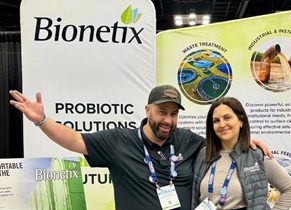
The WWETT convention is a great place to get immersed in the world of wastewater and environmental services, as our Bionetix® team learned firsthand during the February 18th-20th convention in Indianapolis. With new and familiar faces coming from as far as Mexico, Peru, Colombia, Chile, and the Netherlands, it was an exciting time to explore future possibilities for international collaboration and see the new BIO-BOOM™ TAB take the spotlight!
While companies are still waking up to the exciting possibilities of friendlier, more sustainable biological treatments such as those in the BIO-BOOM™ product line, our new tablet version, released in December, was of special interest to companies that service portable toilets in winter environments. Portable restroom operators may have to wait up to five minutes for one portable toilet treatment pouch to dissolve in low temperatures, a loss of time that can add up to serious delays on the treatment route. While liquid treatments are a faster alternative, their downside is the lack of portion control, which may lead to excessive use and unnecessary waste. In contrast, our Bionetix® team showed how BIO-BOOM™ TAB, the only tablet of its kind, was able to dissolve in ice water at the booth. This fast dissolving technology also gives users the benefits of precise and controlled dosing, enabling service companies to increase efficiency on their routes.
The eager reception of the BIO-BOOM™ TAB underscores the leadership and growing traction of Bionetix® as an innovative manufacturer of biological treatments, and we anticipate seeing potential future collaborations unfold from the connections made at WWETT 2025. Together, we look forward to making the job safer and easier for portable toilet service companies! Contact us to learn more about this and other biological treatments presented at WWETT.
Keywords: BIO-BOOM TAB, WWETT2025, wastewater treatment, environmental services, portable toilet treatment, winter tips for portable toilets, portable toilet service providers, biological toilet treatment, Bionetix, non-biocide treatments for portable toilets
For a PDF version please click here.
PRESS RELEASE: Transforming the Textile Industry with Sustainable Biological Solutions
The textile industry often struggles with a negative environmental image from the large quantities of dyes and other chemicals used to make fabric and leather. In addition to worker hazards, these chemicals present challenges for wastewater treatment. Fortunately, many biological solutions in the form of enzymes and probiotics are now available to make various aspects of the textile industry friendlier to workers and the environment.

The Expertise of Enzymes
Commercial enzymes such as those sourced from microorganisms are a great boon to textile processors because of their inherent benefits and/or potential to replace harsh chemicals. For example, enzymes available from Bionetix® International offer the following possibilities:
- ECL1000™ is a liquid amylase concentrate that can be used to remove starch during desizing of fabric.
- ECP1611™ is a powder enzyme concentrate containing protease with keratinase activity. This combination is ideal for removing hair in leather processing. It can also help with wool finishing for a smoother texter.
- ECL1200™ is a liquid lipase concentrate that can be used to degrease leather and bio-scour wool, replacing harsh and/or polluting chemicals normally used for these operations. It can also be used to pretreat wool for improved dyeing.
- ECL3000™ is a liquid cellulase concentrate that can be used for bio-polishing of plant-based fabrics, removing extraneous fibers for a smoother finish. Bio-stoning is another use, cutting down on the number of pumice stones needed to fade denim.
The Power of Probiotics
Although enzymes can replace some of the harsh chemicals that might otherwise end up in wastewater, textile effluent still has plenty of concentrated waste materials that need to be treated before the remaining water can be safely released to the environment. That is where bioaugmentation with probiotics (i.e., beneficial bacteria) takes over. Bioaugmentation introduces microbial reinforcements to any naturally-occurring colonies already present in wastewater material during the biological treatment stage at the wastewater treatment plant. Supplementary microbes should be chosen based on their ability to speed up the biodegradation of specific substances. In textile wastewater, these pollutants may include starches, surfactants, hydrocarbons, greases, ammonia, and nitrogen, reflected in characteristics such as high overall COD (chemical oxygen demand), BOD (biochemical oxygen demand), TSS (total suspended solids), and TKN (total Kjeldahl nitrogen) that increase wastewater surcharges. A variety of nutrient blends that target specific substances and help improve key wastewater quality markers like these are also available from Bionetix®:
- BCP10™ contains microorganisms that degrade complex organic chemicals such as phenols and surfactants, thus enhancing overall BOD/COD removal.
- BCP11™ improves effluent quality in industries with high chemical content such as solvents.
- BCP22™ is designed for wastewater with high concentrations of greases. Although often associated with the food industry, BCP22™ can also be used to degrade excess FOG (fats, oils, greases) produced by leather degreasing.
- BCP35M™ degrades hydrocarbons and other organic waste
- BCP55™ targets the degradation of starch, present in textile wastewater as a residual of the desizing process.
- BCP655™ consumes organic and inorganic nitrogen, reducing ammonia levels and eliminating expensive surcharges for high TKN discharge levels.
Specific treatment will vary from site to site, but when working with a technical consultant, textile facilities can stay one step ahead of high surcharges from excess contaminant levels in wastewater effluent. Incorporating enzymes into the manufacturing process and adding the right “bugs” to wastewater are two sustainable solutions for the textile industry to take advantage of for practical as well as ecological reasons. Contact Bionetix® to get more advice on
transforming your textile operations for a greener, more sustainable future.
Keywords: textile industry, sustainability, bioaugmentation, textile wastewater treatment, enzymes for manufacturing, cellulase suppliers, lipase suppliers, amylase suppliers, protease suppliers, Bionetix
Need a High-Resolution Photo? Please Visit: www.cortecadvertising.com
For a PDF version please click here.
FEATURED IN: Bionetix International BIO-BOOM TAB Probiotic Treatment Featured in Product News
FEATURED IN: Bionetix Launches New Cleaning Concentrate Featured in Service Truck Magazine
PRESS RELEASE: Four Nature-Based Ways to Create the Lawn of Your Dreams
Meteorological summer is more than half over in the Southern Hemisphere. Spring is on its way in the north. Whatever hemisphere you find yourself in, now is a great time to think about pursuing your dreams for a greener lawn. While you could opt for a quick dose of synthetic fertilizer for fast results, Bionetix® International recommends four nature-based treatments to enhance the overall health of the soil for long-term benefits.

1. Enrich the Soil with Organic-Based Fertilizer
Making sure you have a rich blend of nutrients is a good place to start. While many synthetic fertilizers major on the “big three”—NPK (nitrogen, phosphorus, and potassium)—ORGANIC PLUS™ draws on NPK from natural sources and adds calcium, magnesium, sulfur, iron, boron, and manganese to the picture. It also contains humic acids to further enrich the soil and improve nutrient absorption. A natural wetting agent supports more efficient use of water to reduce drought stress. Application is especially beneficial for new growth in early spring but can continue weekly as the grass matures.
2. Improve Soil Structure and Biology
Often, organic fertilizers need the help of microorganisms to make nutrients available to grass roots. A biofertilizer such as ECO-TURF™ is perfect for this purpose. In addition to various minerals, vitamins, and plant extracts, ECOTURF™ contains 75 million CFU (colony forming units) of beneficial bacteria per mL. These microorganisms help break down organic matter, creating a nutrient rich soil structure that can support vigorous leaf, stem, and root growth. ECO TURF™ may be applied by sprayer or irrigation system every two to four weeks.
3. Thin Out the Thatch
The longer summer goes and the grass continues to grow, the more thatch and dead organic materials build up in the lawn. Since this makes it harder for water and oxygen to reach the grass’s roots, mechanical dethatching is often recommended. However, ECO-D-THATCH™ serves as an excellent supplement to or replacement for mechanical dethatching. This biotreatment uses beneficial bacteria and enzymes to break down thatch and organic debris, creating more nutrient rich humus while giving oxygen and water better access to soil and roots. ECO-D-THATCH™ should be applied every two to four weeks.
4. Activate Plant Growth
SOIL-BAC™ Premium can take your lawn another step further in healthy growth and nutrient breakdown. PGPR (plant growth promoting rhizobacteria) serves as a natural plant growth hormone while mycorrhizae help increase active biomass. Another special feature is the use of both symbiotic and free-living bacteria to help fixate atmospheric nitrogen. These components increase nutrient availability and facilitate absorption—even before vegetation begins to grow in the spring.
Follow Your Dreams to a Healthy Lawn!
There are many great strategies to grow a healthy lawn. While you could take the fast route of synthetic fertilizers that leave behind unwanted runoff and contamination, a better approach is to focus on creating healthy soil with natural drought resistance and growth promoters, beneficial microorganisms, and a wide range of nutrients. It’s not too late to finish the lawncare season strong in the Southern Hemisphere—or too early to dream of lush green turf in the Northern Hemisphere. Contact Bionetix®to get started harnessing the power of nature to create the lawn of your dreams!
Keywords: create the lawn of your dreams, natural lawncare, organic fertilizer, pros and cons of synthetic fertilizer, Bionetix, dethatching tips, healthy lawns, biofertilizer, drought resistant lawns, tips for better lawns
Need a High-Resolution Photo? Please Visit: www.cortecadvertising.com
For a PDF version please click here.

